20 Aug 2026
Intellectual Property & Technology
Will the real Swim Shady please stand up? Lessons learnt from Eminem’s recent trade mark battle

Aldi is no stranger to ‘dupe’ culture. Don’t want to splurge on Nutella? How about Aldi’s Nutoka Hazelnut Spread instead? With Smith’s crinkle cut chips sometimes encroaching on $9 a bag, why not opt for Aldi’s Sprinter’s crinkle cut chips?
From yoghurt to washing powder to wheels of camembert, Aldi strives to create a cheaper but strikingly similar version of all the items you love.
On 17 December 2024, the Federal Court of Australia handed down its judgment on Hampden Holdings I.P. Pty Ltd v Aldi Foods Pty Ltd [2024] FCA 1452. In that matter, Moshinsky J held that Aldi Foods Pty Ltd’s (Aldi) use of certain packaging for its “Mamia” products infringed the copyright contained in the “Baby Bellies” packaging owned by Hampden Holdings (Hampden).
Moshinsky J went as far as to describe Aldi’s infringement as ‘flagrant’, stating:
Aldi sought to use for its own commercial advantage the designs that had been developed by a trade rival. Although Aldi may have intended, if possible, to avoid infringement and legal liability, it took the risk that its use of the BELLIES designs would exceed what the law allows. I consider Aldi’s conduct to be flagrant.1
This decision was appealed by Aldi to the FCAFC and was met with a cross appeal from Hampden, who claimed Moshinsky J’s original ruling did not go far enough.
On 19 August 2026, at the Full Court of Appeal of the Federal Court (FCAFC), judgment was handed down that shed light on the Full Court’s perspective on the creation of strikingly similar products in Aldi Foods Pty Limited v Hampden Holdings I.P. Pty Limited[2026] FCAFC 103.
The judgment in the appeal appears to represent a mixed outcome, with both the appeal and cross-appeal succeeding in part. Upon closer examination, however, we see that the overall result was more favourable to Hampden. In the judgment, the FCAFC specifically noted that Aldi had “gone slightly backwards overall”2, despite partial success for both parties.
Burley, Moore and Owens JJ of the FCAFC agreed that a number of Aldi’s works infringed copyright but departed from Moshinsky J’s methodology for assessing similarity. While this aspect of Aldi’s appeal was successful, the Court’s revised approach ultimately resulted in a wider range of Aldi products being deemed as infringing copyright, leading to partial success on Hampden’s cross-appeal.
The Court also affirmed the finding of ‘flagrant’ infringement made at first instance, extending that finding to the broader category of infringing works identified on appeal.
Ultimately, the Court concluded that both Aldi and Hampden had succeeded on their appeal and cross appeal in demonstrating that the primary judge failed to apply the correct approach to the circumstances in this case.3
Although Hampden Holdings was not awarded its appellate costs because each party achieved some measure of success, the Court observed that Aldi had, in overall terms, emerged from the appeal in a less favourable position than before.
Moshinsky J found that certain Aldi works reproduced a qualitatively substantial part of the “layout and design elements” contained in Hampden’s Baby Bellies works, including the oval shaped cartoon character with a light-coloured belly.6
The FCAFC accepted that Moshinsky J’s examination of the design elements was comprehensive, but nevertheless disagreed with his methodology, holding that the assessment of whether a “substantial part” had been copied could not rest on his “abstracted” features.7
Rather, they found:
one must have regard to all of the similarities (which may not be identical as to any part), which might include style, technique, colour, and visual or design elements, and then consider whether those similarities constitute a substantial part of the copyright work.8
In addition to this, the FCAFC disagreed with Moshinsky J’s take on copying a ‘style’ or ‘technique’ in creation.
Consider a distinctly original riff or brushstroke technique. For example, the iconic opening riff of ACDC’s ‘Back in Black’, Vincent van Gogh’s thick, swirling brushstroke techniques, or another element involving significant skill and labour which may attract protection. Where the impugned work reproduces such original or labour-intensive features, it may infringe despite other differences identified through a side-by-side comparison.
The FCAFC’s approach is useful and provides sound guidance for future matters of this nature. Focusing on abstract descriptions of a work may overlook specific original features that are important to the infringement analysis. Rather than relying on broad, summarising characterisations, courts must closely compare the works in detail and assess the significance of their similarities and differences, recognising that infringement findings often involve “questions of degree”9 and depend heavily on the quality of the evidence and visual comparisons.
Rather than protecting a general “look and feel”, copyright protects the particular expression embodied in a work, including any original combination and arrangement of elements. The FCAFC decided it must therefore compare the specific copyright work with the alleged infringement and assess whether the similarities, viewed in light of the differences, amount to the reproduction of a substantial part of that work.10
The FCAFC emphasised that originality matters not only when determining whether copyright enlivens, but also when assessing whether a substantial part of a work has been reproduced. In this case, evidence provided by the designer of the creative choices underlying Hampden’s Baby Bellies packaging, including its colour palette, typography, photography and layout, assisted the FCAFC in identifying the work’s original expression and evaluating whether those original features had been appropriated.
Out of the side-by-side comparisons between Hampden and Aldi’s products provided to the FCAFC, they upheld three of Aldi’s works as being infringing, and added an additional two to the list. In the FCAFC’s ruling published on the Federal Court website, they included copies of the images referenced in each judgement. One example of Aldi’s products found to infringe is displayed below.
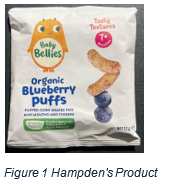
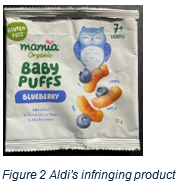
However, Hampden could not score a home run against all of Aldi’s ‘duped’ baby snack products. The FCAFC’s findings varied depending on the particular copyright work said to have been infringed. While some products were found to reproduce protected features of Hampden’s Baby Bellies works, others were sufficiently differentiated by their colours, imagery, ingredients and character designs, with the FCAFC assessing each alleged infringement individually rather than comparing the product ranges as a whole.
In total, six of the products put forward as potentially infringing were found to not infringe Hampden’s copyright:11
The FCAFC recognises that in reference to the above example, “the present case is certainly not an easy or clear-cut case.”12 However, the FCAFC found that Aldi had not reproduced a substantial part of the relevant Hampden design because key distinctive features were absent, including the colour and appearance of the character and accompanying design elements, such that Aldi had not appropriated the original aspects of the work relied upon by Hampden.
This partial success for Aldi may be surprising to some, considering Aldi’s graphic designers were briefed to develop packaging that resembled Hampden’s Baby Bellies design architecture. This is known as “benchmarking” and is a common commercial practice. When done right, it avoids an infringement and provides Aldi with great commercial success around the world.
“Look and feel” is not covered by copyright.
Keep side-by-side comparisons in mind when assessing infringement.
’Originality’ is a key factor.
The choices made by Hampden’s original designer, who gave evidence during the trial, greatly assisted Hampden’s case. The font, specific colour, layout and photography choices made by that designer all contributed to the originality of the design, which is relevant when assessing whether a substantial part of the design had been copied.
If you’re concerned that someone has duplicated or stolen your original design, do not hesitate to reach out to Lavan’s Dispute Resolution and Investigations team for further advice. Conversely, if you are seeking to create an original design, be aware of the above test. Again, we may be able to advise you if your design is going to be problematic.
Thank you to solicitor Isabella Beilin for her research and contribution to this article.
The information contained in this publication does not constitute legal advice and should not be relied upon as such. You should seek legal advice in relation to any particular matter you may have before relying or acting on this information. The Lavan team are here to assist.

"*" indicates required fields