

13 Jul 2026
Migration
Migration changes from 1 July 2026: Higher migration income thresholds and visa fee hikes

There has been plenty of commentary in the media and migration industry about Australia’s latest changes to skilled visa processing.
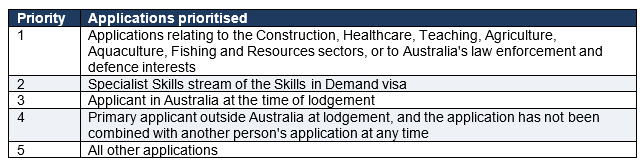
New Ministerial Directions 121 and 122, which commenced on 19 September 2026, replace the skilled visa processing priorities previously set out in Ministerial Direction 119 and introduce a revised framework for how the Department of Home Affairs prioritises skilled visa applications.
In this publication we examine the key changes, who they affect, and the practical implications for skilled visa applicants and sponsoring employers.
Firstly, what is Ministerial Direction?
A Ministerial Direction provides the Government with a flexible mechanism for influencing how Australia’s migration laws are administered. Under section 499 of the Migration Act 1958 (Act), the Minister may give written directions to persons or bodies exercising powers or functions under the Act, which relevant decision-makers are generally required to follow. Importantly, a Ministerial Direction does not amend the underlying legislation; rather, it can change the way in which decision-makers are required to exercise their powers. This enables the Government to respond relatively quickly to changing migration priorities without the need to amend the Act itself.
Ministerial Direction 119, dated 24 July 2026, set processing priorities for skilled visas and nominations. On 18 September 2026 the Minister signed two replacement directions, which commenced on 19 September 2026. Section 3 of Direction 121 revokes Direction 119, and the two new directions replace all of its processing priorities.
The key changes compared with Direction 119 are:
Direction 121 applies to Skills in Demand (subclass 482) visas and legacy Temporary Skill Shortage (subclass 482) visas. (The Skills in Demand visa replaced the Temporary Skill Shortage visa on 7 December 2024.)
Direction 122 covers subclasses 186, 187, 189, 190, 191, 489, 491, 494, 887 and 888. Where a subclass is capped under section 85 of the Act, the same order determines which applications receive the available places.
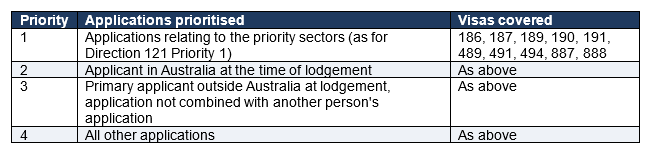
Under both directions, secondary applicants who apply together with the primary applicant share the primary applicant’s priority level. The directions do not apply to Administrative Review Tribunal remittals or substituted decisions (and, under Direction 122, former Administrative Appeal Tribunal remittals or substituted decisions also), applications that plainly cannot meet the grant criteria for the visa, or family members applying separately from an onshore primary applicant.
Officers must depart from the order in compelling circumstances. Direction 121 gives as examples community safety, continuity of essential religious, cultural or community services, and Australia’s international relations; Direction 122 lists only the first two.
Employers in the newly added sectors, particularly agriculture, aquaculture, fishing and resources, and those recruiting priority-sector workers from overseas may see their visa applicants’ applications move up the queue. Employers recruiting in non-priority occupations, especially offshore, should expect their visa applicants’ applications to sit lower in the order, behind a larger group of highest-priority applications.
Priority does not shorten the assessment itself, and the Department of Home Affairs has not published processing times for each priority level. It has warned that processing times may fluctuate while pending applications are reprioritised. With nominations outside both directions, nomination timing is also less predictable.
The information contained in this publication does not constitute legal advice and should not be relied upon as such. You should seek legal advice in relation to any particular matter you may have before relying or acting on this information. The Lavan team are here to assist.

"*" indicates required fields