

10 Jun 2026
Restructuring & Insolvency
Lessons from Lavan: Navigating the “No Profit Rule” in a Committee of Inspection

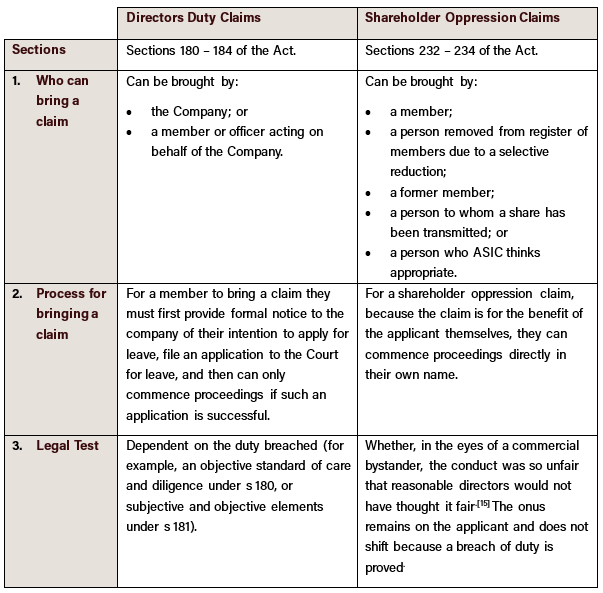
In Our Jim & Felicja Superfund Pty Ltd as trustee for the Jim & Felicja Superannuation Fund v Lindenfels Pte Ltd [2026] FCA 307 (Felicja), the Federal Court of Australia (Halley J) considered the relationship between claims for breaches of directors’ duties and claims for shareholder oppression under s 232 of the Corporations Act 2001 (Cth) (the Act).
For directors and boards, Felicja confirms that oppression claims and breaches of directors duties’ can be founded on the same facts and often overlap, but that care should be taken to ensure that the two are not conflated.
They are different claims with different remedies. A breach of directors’ duties is not automatically oppression, and an oppression claim is not to be used as a back door to compensation or an account of profits.
Batchfire Resources Pty Ltd (Batchfire) acquired the Callide Mine in October 2016 with a “Turnaround Plan” to make it profitable. Its principal investor, Avra Commodities Pte Ltd (Avra), held a majority shareholding in Batchfire through Lindenfels Pte Ltd (Lindenfels). As a condition of its investment, Avra was appointed exclusive marketing agent for Batchfire’s export coal under an Agency Agreement, and given the right to purchase that coal under an Offtake Agreement.
The Turnaround Plan failed. The minority shareholders alleged that Avra and its nominee director, Ben Burgess, set out to make Batchfire a “captive producer” for Avra’s coal trading business, leaving it no choice but to sell export coal to Avra at undervalue, and forced the 2019 and 2020 rights issues so that Lindenfels could take control cheaply. They claimed breach of fiduciary duties by Avra, breach of directors’ duties by Mr Burgess, and oppression under s 232 of the Act.
Halley J dismissed the proceeding with costs, finding that Avra’s marketing obligations were contractual, not fiduciary, and its right to buy export coal was a freely negotiated entitlement under arrangements Batchfire had “willingly entered into with its eyes open”. The rights issues stemmed from operational challenges and Batchfire’s failure to raise the $90 million investment the Turnaround Plan relied on, not from the defendants’ conduct. Mr Burgess did not breach his duties, and the oppression claim was not made out.
Directors owe the company statutory duties under ss 180 to 183 of the Act, alongside the equivalent general law duties (see s 185). A claim for their breach belongs to the company, and a member may only pursue it by a derivative action in the name of the company with leave under s 237.
By contrast, a member may bring an oppression claim under s 232 in their own right, and the Court may make any order it considers appropriate under s 233.
The case law has long recognised that the same facts will often give rise to both claims. In Campbell v Backoffice Investments Pty Ltd (2008) 66 ACSR 359, Basten JA observed that ‘it is not tenable that there be a bright line separating cases involving misfeasance by directors from cases involving oppression’.[1]
Halley J confirmed in Felicja that, despite their overlap, the claims differ in how they are brought and the remedies available, and ‘there is no necessary connection between the two causes of action’.[2]
In Felicja, the plaintiffs argued that a finding that a director had breached a duty shifted the evidentiary burden to the defendants to prove that the conduct was not unfair under s 232(e) of the Act,[3] and made unfairness more readily established.[4] Halley J rejected both arguments. Referring to Jenkins v Enterprise Gold Mines NL (1992) 6 ACSR 539, his Honour explained that a breach of fiduciary duty is relevant to, but does not establish, unfairness.[5] The onus always remains on the party alleging oppression,[6] and the critical question is whether the conduct is commercially unfair, not whether it was otherwise unlawful.[7]
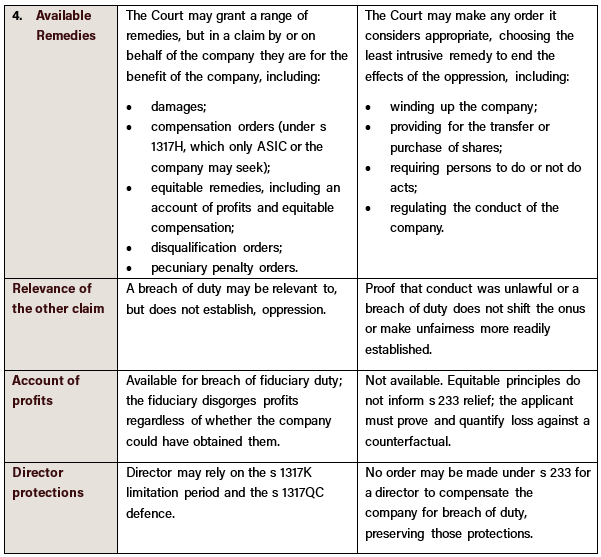
Halley J observed that, had the plaintiffs brought a derivative action in Batchfire’s name against Avra under ss 236 and 237 of the Act, an account of profits ‘would have provided a straightforward manner by which they could obtain relief’.[8] By proceeding under s 232 instead, the plaintiffs avoided the need to obtain leave,[9] but were required to identify a counterfactual and prove and quantify their loss, which required extensive expert evidence.[10]
His Honour confirmed that equitable principles do not govern relief under s 233, even where the oppressive conduct also constitutes a breach of fiduciary duty,[11] so an account of profits would not have been available. [12] Nor can an order be made under s 233 requiring a director to compensate the company for breaches of statutory or fiduciary duties. Halley J followed Re Estate Soulos [2022] NSWSC 1507 in preference to the broader statements in Parker v Auswild [2022] VSCA 8. [13] In his Honour’s view, permitting orders for compensatory relief in an oppression claim would deprive directors of the s 1317K limitation period and the s 1317QC defence available in a derivative suit, and the Court’s task under s 233 is to end the effects of the oppression by the least intrusive remedy, ‘not holding directors to account for breaches of statutory and fiduciary duties’.[14]
Halley J’s decision confirms that the choice of procedure has real consequences. Proceeding by way of an oppression claim avoids the need to obtain leave to bring a derivative action, but it may require the plaintiff to discharge a heavier burden in proving and quantifying any loss alleged, and it offers a narrower range of remedies than a derivative action for breach of directors’ duties, under which gain-based relief such as an account of profits may be available.
For businesses, directors and shareholders, the decision has several practical implications:
The information contained in this publication does not constitute legal advice and should not be relied upon as such. You should seek legal advice in relation to any particular matter you may have before relying or acting on this information. The Lavan team are here to assist.

"*" indicates required fields